





















































































































































Struggling to Lose Weight Despite Trying? 12 Evidence-Based Reasons
Author: RVLNSV PRASAD
Updated On: September 2026
About Us
Author Bio
Editorial Policy
Contact Us
Quick Answer
If you are struggling to lose weight despite trying, it does not automatically mean that you lack discipline or that your metabolism is “broken.”
Weight loss can slow because your body requires fewer calories after losing weight. Appetite may increase, portions can gradually become larger, daily movement can change, and sleep or stress can make healthy habits harder to maintain.
Some medications and medical conditions can also affect weight management.
The CDC explains that healthy weight management involves eating patterns, physical activity, sleep, and stress management, while factors such as medications, medical conditions, hormones, age, genetics, and environment can also affect weight.
The answer is usually not another extreme diet.
A better approach is to identify what has changed, review your current habits, make realistic adjustments, and seek professional advice when an underlying medical issue may be involved.
Key Takeaways
- A weight-loss plateau does not necessarily mean your efforts have failed.
- Your calorie needs can decrease after you lose weight.
- Appetite may increase during weight loss.
- Portion sizes and liquid calories can quietly increase your overall intake.
- Weekend eating can sometimes offset weekday efforts.
- You do not need to eliminate carbohydrates to lose weight.
- Protein-rich and high-fiber foods can make meals more satisfying.
- Regular movement matters beyond formal exercise sessions.
- Strength training can complement aerobic activity.
- Sleep and stress can influence your ability to maintain healthy habits.
- Some medications and medical conditions can affect weight.
- Tracking can reveal patterns that are difficult to notice from memory.
- Persistent or unexplained difficulty losing weight deserves professional evaluation.
Why Am I Struggling to Lose Weight Despite Trying?
One of the most frustrating experiences is putting effort into weight loss and seeing little change on the scale.
- You may have reduced portions.
- You may be exercising regularly.
- You may have stopped drinking sugary beverages.
- You may even have lost several kilograms already.
Then progress slows.
At this point, many people think:
“Why am I not losing weight anymore?”
The answer is rarely one single factor.
Weight management is influenced by food intake and physical activity, but the body also adapts as weight changes. Appetite, energy requirements, movement, and behavior can change over time.
A 2024 review examined possible reasons people do not lose weight as expected despite participating in weight-loss programs. It identified multiple categories of influences, including biological, medical, lifestyle, intervention, and environmental factors, along with substantial individual differences in response.
That is why the more useful question is not
“Why can’t I lose weight?”
Instead ask:
“What could be preventing my current plan from working as well as it did before?”
That question gives you something practical to investigate.
1. Your Calorie Needs May Have Changed After Losing Weight
This is one of the most important reasons weight loss can slow.
Suppose you previously weighed considerably more and then lost several kilograms.
Your body now has less mass to maintain and move.
Consequently, your energy requirements may be lower than they were at your previous weight.
NIDDK explains that metabolism slows during weight loss and that the body needs fewer calories at a lower weight.
NIDDK — Eating & Physical Activity to Lose or Maintain Weight
This means an eating pattern that created a calorie deficit at the beginning of your journey may eventually produce a much smaller deficit.
That does not mean your metabolism is permanently damaged.
It means your body has changed.
What Can You Do?
Do not immediately respond to a plateau by dramatically cutting calories.
First, review your current eating pattern, portions, drinks, and activity.
You can also use the NIH Body Weight Planner to explore how changes in calorie intake and physical activity may affect weight over time.
The goal is to understand your current situation rather than punish yourself for reaching a plateau.
2. Your Appetite May Have Increased
Another reason you may be struggling to lose weight despite trying is increased hunger.
Weight loss can trigger biological responses that make continued restriction more difficult.
Research discussed by NIDDK found that appetite can increase after weight loss and may act as part of the body’s feedback system opposing further weight reduction.
NIDDK — Weight Loss Leads to Increased Appetite
This matters because increased hunger can gradually affect your eating behavior.
- You may start taking larger portions.
- You may snack more often.
- You may find it harder to resist highly palatable foods.
- You may also feel that you are exercising the same amount while eating slightly more.
Instead of responding by simply trying to tolerate extreme hunger, make meals more satisfying.
Include appropriate portions of protein-rich foods, vegetables, fruits, whole grains, and other high-fiber foods.
The goal is not to eliminate hunger completely.
The goal is to make your eating pattern easier to maintain.
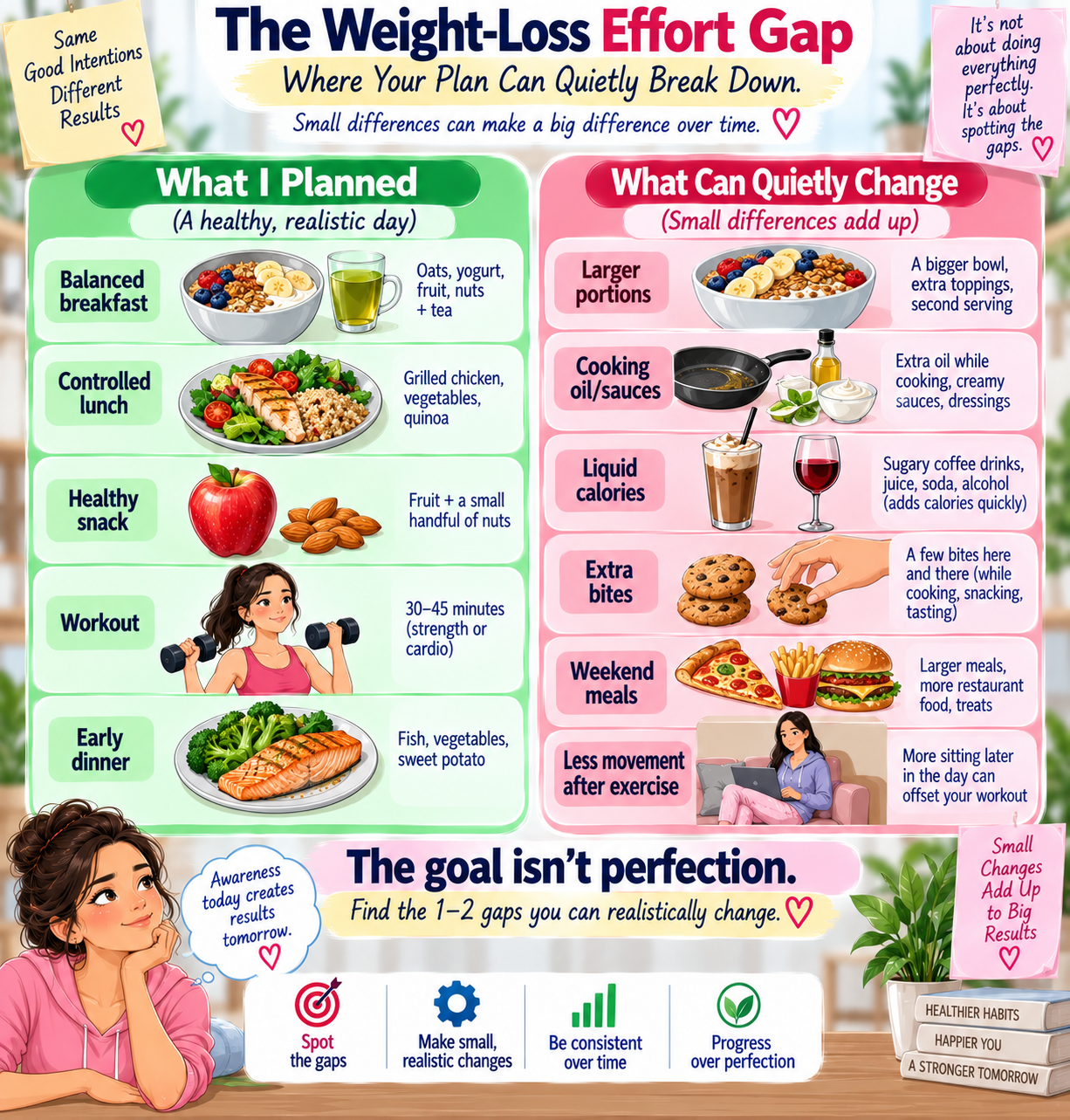
3. Your Portions May Have Quietly Increased
You do not have to eat fast food every day to stop losing weight.
Small increases can add up.
Consider:
- An extra spoonful of cooking oil
- A larger handful of nuts
- A second serving of rice
- A larger coffee
- An extra snack
- A few bites while cooking
- Larger restaurant portions
Each change may seem insignificant.
Together, however, they can affect your total intake.
NIDDK provides guidance on understanding food portions and choosing an amount that fits your needs.
NIDDK — Food Portions: Choosing Just Enough for You
Try a Seven-Day Portion Audit
For one week, simply observe:
- Cooking oils
- Sauces
- Snacks
- Sugary drinks
- Alcohol
- Restaurant meals
- Second servings
- Nuts and seeds
- Desserts
Do not use this as a reason to criticize yourself.
Use it as information.
Sometimes the problem is not that your diet is unhealthy.
Your current intake may simply be higher than you realize.
4. Your Weekends May Be Offsetting Your Weekday Efforts
You may eat carefully from Monday through Friday and still feel confused about why you are not losing weight despite diet and exercise.
One possible reason is that your weekend eating pattern is substantially different.
A few restaurant meals, desserts, drinks, or large portions can reduce the calorie deficit created during the week.
You do not need a perfect weekend.
Instead, aim for consistency with flexibility.
NIDDK emphasizes that setbacks are normal and recommends returning to healthy habits rather than treating a setback as failure.
NIDDK — Eating & Physical Activity to Lose or Maintain Weight
Think:
“I had a larger meal.”
Not:
“My diet is ruined.”
The first mindset allows you to return to your normal routine at the next meal.
5. Liquid Calories May Be Easy to Miss
Drinks can contribute calories without feeling like a substantial meal.
Examples include:
- Sweetened tea
- Sugary coffee
- Soft drinks
- Fruit drinks
- Energy drinks
- Alcohol
- Large specialty coffees
You do not have to drink only plain water.
But if you regularly consume high-calorie drinks, replacing some of them with lower-calorie choices can be a relatively simple change.
The CDC recommends focusing on sustainable eating and drinking habits as part of healthy weight management.
6. Your Daily Movement May Have Decreased
You may exercise several times a week but move less during the rest of the day.
For example, you begin going to the gym.
But you feel tired afterward.
- You sit longer.
- You walk less.
- You use the car for short journeys.
- You spend more time at your desk.
The formal workout is still happening, but your total daily movement may have changed.
NIDDK recommends regular physical activity and provides practical strategies for becoming and staying active.
NIDDK — Eating & Physical Activity to Lose or Maintain Weight
Easy Ways to Add Movement
Try:
- Walking after meals
- Taking stairs when practical
- Walking during phone calls
- Standing periodically during long work sessions
- Household chores
- Gardening
- Playing with children
- Short movement breaks
You do not need to turn every day into an exhausting workout.
The goal is to make movement part of normal life.
7. You May Need More Than Cardio
Walking and aerobic exercise are useful, but resistance training can also be valuable.
Strength exercises can help maintain and build muscle and improve physical function.
Options include:
- Squats
- Lunges
- Wall push-ups
- Resistance-band exercises
- Dumbbell exercises
- Bodyweight exercises
You do not need an expensive gym membership to begin.
Start at an appropriate level and progress gradually.
The CDC recommends combining physical activity with healthy eating as part of weight management rather than relying on exercise alone.
8. Poor Sleep May Be Making Weight Management Harder
Sleep is sometimes treated as separate from weight loss.
It should be part of the bigger picture.
The CDC includes adequate sleep among the lifestyle factors that support healthy weight management.
Poor sleep can make healthy routines harder.
- You may feel tired.
- You may move less.
- You may have less energy for meal preparation.
- You may find it harder to maintain your normal eating pattern.
One poor night’s sleep does not explain your entire weight trajectory.
The concern is a repeated pattern.
Try a Simple Sleep Experiment
For two weeks:
- Keep your bedtime reasonably consistent.
- Keep your wake time reasonably consistent.
- Reduce unnecessary late-night screen use.
- Prepare for the next day earlier.
- Give yourself enough time in bed.
Treat sleep as part of health rather than another weight-loss trick.
9. Stress May Be Disrupting Your Eating Pattern
Stress does not simply “turn food into fat.”
The practical issue is how stress can affect behavior.
When stressed, some people:
- Skip meals and later overeat
- Snack while working
- Eat quickly
- Sleep poorly
- Move less
- Choose convenient foods
- Eat for emotional comfort
If this happens, telling yourself to “use more willpower” may not solve the problem.
Changing the environment can be more practical.
Keep convenient, nutritious foods available.
Plan meals before your busiest periods.
Take short walking breaks.
Create a simple evening routine.
NIDDK’s behavior-change resources emphasize identifying barriers, making realistic changes, and building habits that can be maintained.
NIDDK — Changing Your Habits for Better Health
10. Your Diet May Be Too Restrictive
Extreme dieting can look attractive because it promises rapid results.
But a plan that is extremely difficult to maintain can eventually lead to frustration, overeating, or abandoning the diet altogether.
- You do not have to eliminate carbohydrates completely.
- You do not have to live on salads.
- You do not need to avoid every food you enjoy.
A sustainable eating pattern can include:
- Vegetables
- Fruits
- Whole grains
- Beans
- Lentils
- Eggs
- Fish
- Lean meats
- Dairy or suitable alternatives
- Nuts and seeds
- Other protein-rich foods
NIDDK recommends healthy eating patterns that include a variety of nutritious foods while supporting long-term weight management.
NIDDK — Eating & Physical Activity to Lose or Maintain Weight
The Six-Month Test
Ask yourself:
“Could I realistically continue eating this way six months from now?”
If the answer is no, your current plan may be unnecessarily restrictive.
11. A Medication or Medical Condition May Be Contributing
Sometimes the reason for difficulty losing weight is not simply food or exercise.
The CDC notes that medications and medical conditions can affect weight management.
Some health conditions and medicines can affect weight, appetite, energy or your ability to remain physically active.
This does not mean that everyone who struggles with weight has a medical disorder.
It means persistent or unexplained changes should not automatically be blamed on willpower.
If you have unexplained weight gain, significant symptoms, or difficulty losing weight despite sustained efforts, speak with your healthcare professional.
Do not stop prescription medication on your own because you suspect it is affecting your weight.
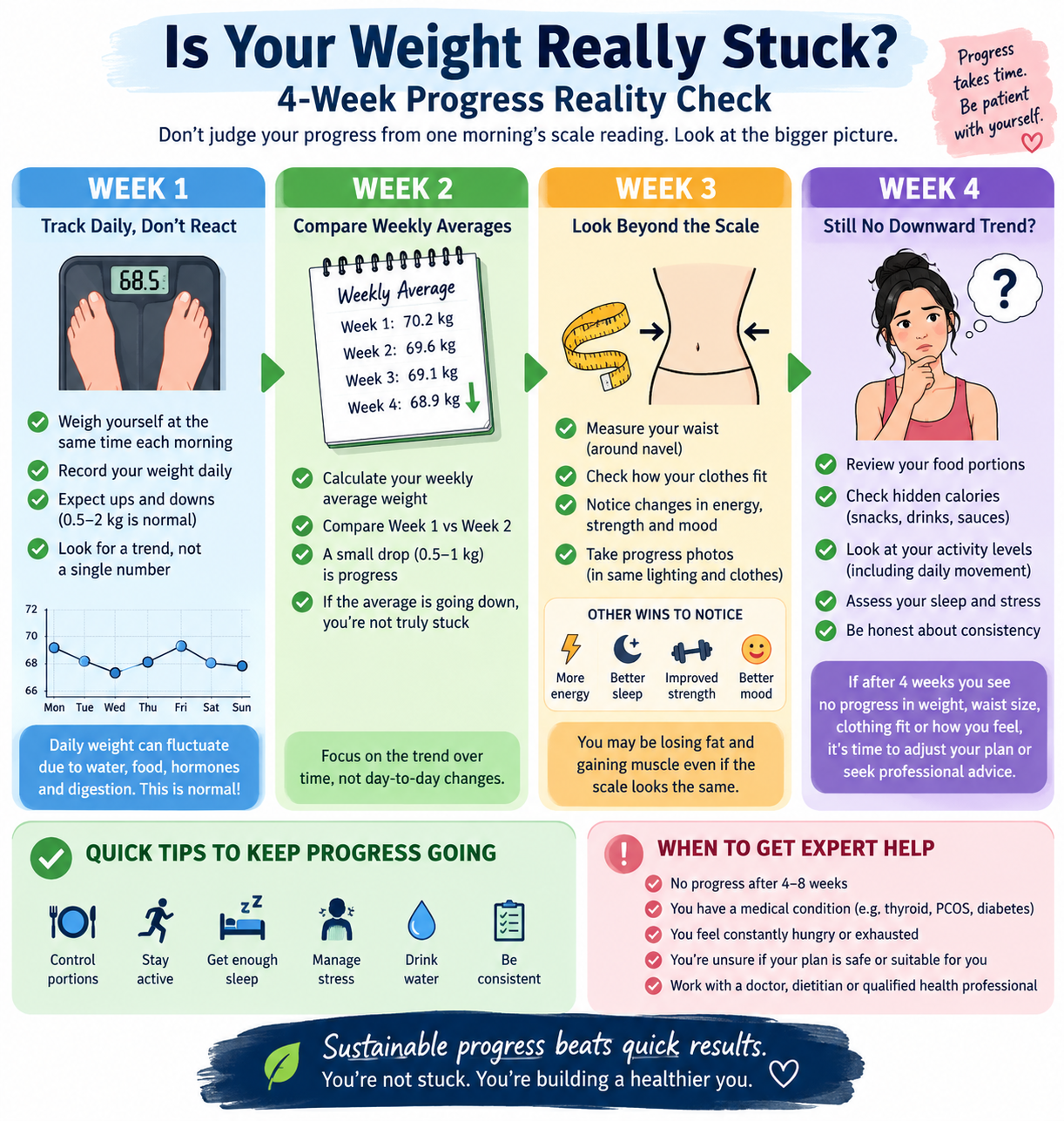
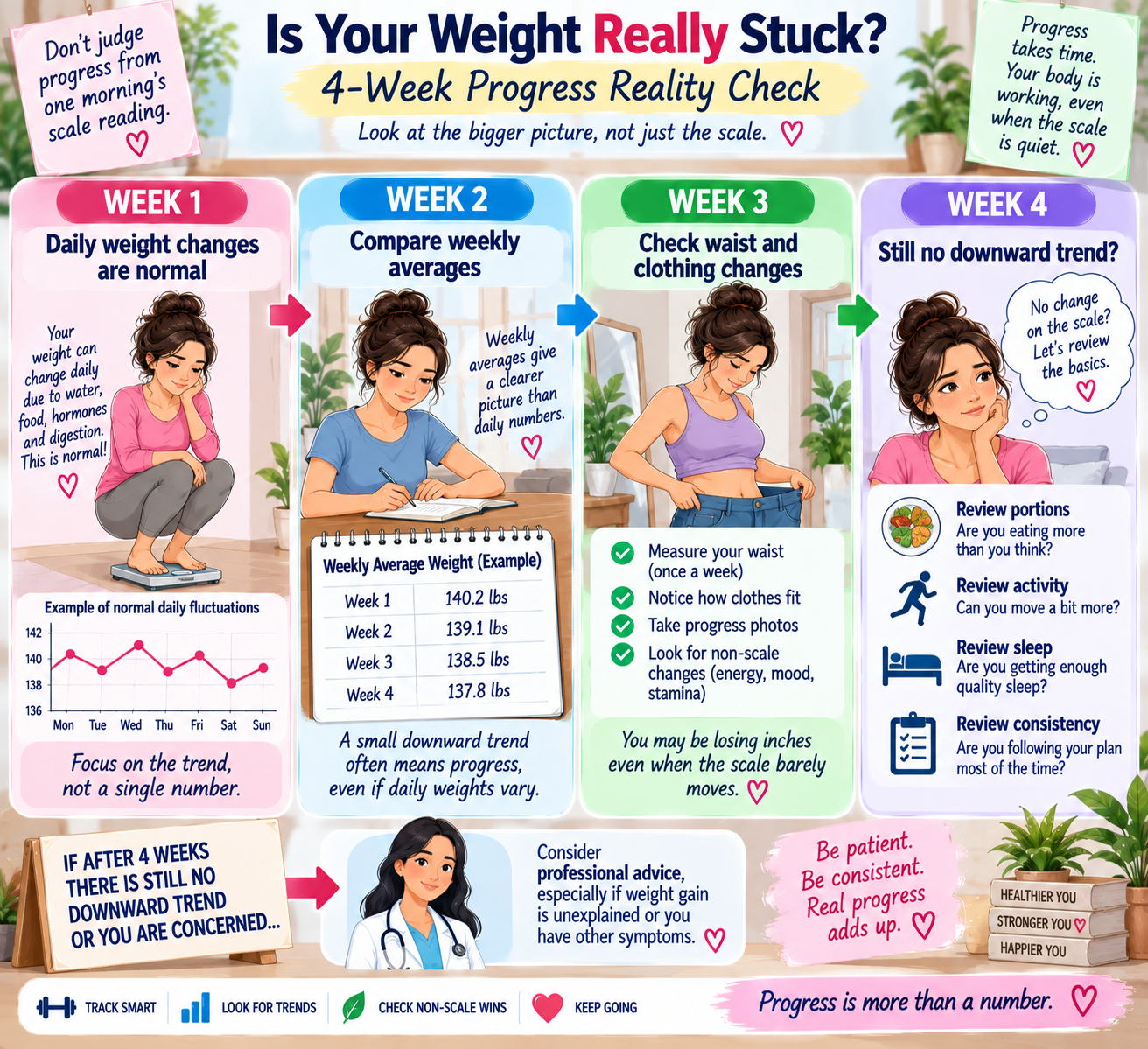
12. You May Be Measuring Progress Too Narrowly
The scale is useful.
But it is not the only measurement.
Body weight can fluctuate because of changes in hydration, food in the digestive system, sodium intake, bowel movements, and other short-term factors.
That means one morning’s number does not necessarily show your long-term progress.
Consider tracking:
| Measure | What it can show |
|---|---|
| Weight trend | Long-term direction |
| Waist measurement | Change in body size |
| Clothing fit | Practical change |
| Strength | Fitness progress |
| Daily movement | Activity consistency |
| Sleep | Recovery pattern |
| Hunger | Diet sustainability |
| Energy | Day-to-day well-being |
NIDDK recommends tracking behaviors and progress as one strategy that can help people understand their habits and maintain changes.
NIDDK — Changing Your Habits for Better Health
The better question is:
“What has my trend looked like over several weeks?”
rather than:
“What did I weigh this morning?”
What Is a Weight-Loss Plateau?
A weight-loss plateau is a period when your weight stops decreasing after previously falling.
It can be frustrating.
But a plateau does not necessarily mean that your body has stopped responding forever.
- Your body weight is lower.
- Your energy needs may be lower.
- Your appetite may have changed.
- Your activity may have changed.
- Your eating pattern may have drifted.
NIDDK explains that energy requirements change with weight and that maintaining weight loss can be challenging because the body adapts.
NIDDK — Eating & Physical Activity to Lose or Maintain Weight
A plateau should therefore be treated as a reason to reassess, not as proof that weight loss is impossible.
What to Do When Your Weight Loss Stalls
Before making a major change, review your routine.
Step 1: Check the trend.
Look at several weeks rather than one or two weigh-ins.
Step 2: Review portions
Pay attention to oils, sauces, snacks, and second servings.
Step 3: Review drinks.
Look for sugary or high-calorie beverages.
Step 4: Review weekends.
Compare your weekday and weekend patterns.
Step 5: Review movement
Has your daily activity decreased?
Step 6: Review hunger
Are you constantly hungry?
If so, your diet may be unnecessarily restrictive.
Step 7: Review sleep
Are you regularly getting adequate sleep?
Step 8: Review stress
Are you eating or moving differently because of stress?
Step 9: Review medications and health
If your weight change is unexplained, speak with a healthcare professional.
NIDDK recommends setting realistic goals, identifying barriers, and developing strategies that can be maintained.
NIDDK — Changing Your Habits for Better Health
A Practical Two-Week Weight-Loss Plateau Reset
Instead of starting another extreme diet, try a simple two-week review.
At Meals
Build meals around vegetables, a suitable protein source, and a sensible portion of carbohydrate or another energy source.
Between Meals
If you are hungry, choose a planned snack rather than waiting until hunger becomes extreme.
Drinks
Make water and other low-calorie drinks your usual choices.
Movement
Add short walks or movement breaks throughout the day.
Exercise
Include aerobic activity and resistance training appropriate to your fitness level.
Sleep
Protect a consistent sleep schedule.
Tracking
Record your weight trend and a few key behaviors.
The purpose is not perfection.
The purpose is to discover what is actually happening.
Easy Habits That Can Help
Start With a Smaller Serving
You can always take more food if you remain hungry.
Eat Without Distractions When Possible
Eating while scrolling or watching television can make it harder to notice portions and hunger cues.
Keep Higher-Calorie Snack Foods Less Visible
NIDDK recommends practical environmental strategies such as keeping tempting foods out of immediate sight.
NIDDK — Changing Your Habits for Better Health
Walk After Meals
A short walk is an easy way to add movement to your day.
Prepare Protein-Rich Foods in Advance
Having convenient foods available can make it easier to build satisfying meals.
Keep a Short Food Record
You do not necessarily need to track forever.
A short period of tracking can reveal patterns that are otherwise easy to miss.
What About “Metabolism-Boosting” Foods?
This is where many weight-loss articles become misleading.
You may see claims about:
- Lemon water
- Green tea
- Apple cider vinegar
- Ginger
- Cinnamon
- Jeera water
- Detox drinks
- Fat-burning spices
Some of these can be perfectly reasonable foods or beverages.
That does not make them powerful weight-loss treatments.
If unsweetened tea helps you replace a high-calorie sugary drink, that substitution can be useful.
But the benefit comes from the overall change in your intake, not from a magical fat-burning effect.
Do not build your entire weight-loss strategy around one drink or ingredient.
Build it around sustainable eating, physical activity, sleep, and behavior.
A People-First Way to Think About Weight Loss
Weight-loss advice often assumes everyone has the same schedule, budget, food preferences, responsibilities, and access to exercise.
Real life is different.
One person may work from home.
Another may work night shifts.
One person may have time to cook.
Another may have family responsibilities.
One person may enjoy the gym.
Another may prefer walking.
That is why the best plan is not necessarily the most aggressive one.
A better question is
“What healthy change can I realistically repeat?”
rather than:
“What is the hardest thing I can do?”
A small habit that survives a busy month can be more valuable than a perfect plan that lasts five days.
Personal Experience: Keep It Genuine
If you include a personal-experience section on your website, it should describe your genuine experience.
Do not present an invented patient or fictional weight-loss result as something that happened to you.
A truthful personal perspective could be:
“One thing I have learned from looking at weight-management advice is that people often focus on one factor, such as food, while overlooking sleep, movement, stress and daily routines. A weight-loss plan becomes more realistic when it fits everyday life instead of requiring perfection.”
If you have personally experienced a weight-loss plateau, you can replace this with your real story, including what you changed and what you learned.
That distinction strengthens reader trust.
Common Mistakes That Can Keep You Stuck
Mistake 1: Cutting calories dramatically whenever the scale stalls
A plateau does not automatically mean you need an extremely low-calorie diet.
Mistake 2: Blaming metabolism for everything
Metabolic adaptation is real, but food intake, appetite, movement, sleep, and behavior also matter.
Mistake 3: Ignoring drinks
Liquid calories can accumulate without feeling like a meal.
Mistake 4: Eating perfectly during the week and overeating on weekends
Look at your complete weekly pattern.
Mistake 5: Exercising only to burn calories
Exercise has benefits beyond the number of calories shown on a fitness tracker.
Mistake 6: Eliminating entire food groups unnecessarily
A sustainable eating pattern can contain carbohydrates and many other foods.
Mistake 7: Depending on “fat burners”
Supplements should not replace sustainable lifestyle habits or appropriate medical treatment.
Mistake 8: Weighing yourself once and declaring failure
Look at trends.
Mistake 9: Expecting perfectly linear weight loss
Real-world weight change often fluctuates.
Mistake 10: Assuming difficulty losing weight is always a willpower problem
Medical conditions, medications, sleep, stress, and environment can all contribute.
When Should You Talk to a Doctor?
Consider professional advice if:
- Your weight is increasing unexpectedly.
- You have unexplained symptoms.
- You suspect a medication is affecting your weight.
- You have persistent difficulty losing weight despite sustained efforts.
- You are considering a very restrictive diet.
- You have a history of disordered eating.
- Your weight is affecting your health, and you want to discuss evidence-based treatment options.
The CDC recommends discussing weight-related concerns and relevant health factors with a healthcare professional.
A healthcare professional can consider your medical history, medications, symptoms, and lifestyle instead of assuming the problem is simply a lack of discipline.
How Much Weight Loss Is Realistic?
Avoid promising yourself an exact amount of weight loss every week.
The CDC describes gradual weight loss of about 1–2 pounds per week as a commonly recommended pace for people who are losing weight, while emphasizing that healthy weight management also involves nutrition, physical activity, sleep, and stress management.
Your individual rate can differ.
Some weeks may show little change.
Other weeks may show a larger change because of normal fluctuations.
The goal is a sustainable trend rather than a perfect weekly number.
Should You Count Calories?
Calorie tracking can be useful for some people.
It can show how much food and drink you are actually consuming and reveal patterns that are difficult to estimate from memory.
But tracking is not mandatory for everyone.
If calorie counting makes you anxious, obsessive, or excessively restrictive, another approach may be more appropriate.
You can instead focus on:
- Portion awareness
- Protein-rich foods
- Vegetables
- Fruit
- High-fiber foods
- Lower-calorie beverages
- Regular movement
- Consistent meal patterns
NIDDK provides guidance on food intake, physical activity, and behavior change as parts of weight management.
NIDDK — Eating & Physical Activity to Lose or Maintain Weight
The Most Useful Question to Ask Yourself
If you are struggling to lose weight despite trying, do not ask only:
“What should I cut out?”
Ask:
“What can I consistently improve?”
Maybe the answer is
- Fewer sugary drinks
- More vegetables
- A protein source at meals
- Smaller restaurant portions
- A daily walk
- Resistance training
- More consistent sleep
- Less weekend overeating
- Better stress management
- Medical evaluation
You do not need to change everything simultaneously.
Choose realistic improvements and build from there.
Frequently Asked Questions
Why am I not losing weight even though I exercise?
Exercise supports health and weight management, but it does not guarantee weight loss. Food intake, appetite, daily movement, sleep, medications, and metabolic adaptation can influence results.
Why am I struggling to lose weight despite dieting?
Your current calorie intake may no longer create the same deficit, particularly after weight loss. Appetite, portions, activity, sleep, stress, and medical factors can also contribute.
Why did I stop losing weight after losing several kilograms?
As body weight decreases, energy requirements generally decrease. Appetite and metabolic responses can also change, making continued weight loss more difficult.
NIDDK — Eating & Physical Activity to Lose or Maintain Weight
Is a weight-loss plateau normal?
Plateaus can occur during weight loss. They are a reason to reassess your routine rather than automatically concluding that weight loss is impossible.
Do I need to stop eating carbohydrates?
No. Carbohydrates can be part of a healthy eating pattern. Overall dietary quality, portions, and total energy intake matter.
Is protein important for weight loss?
Protein-rich foods can be part of a satisfying, balanced eating pattern. Examples include eggs, fish, poultry, dairy, beans, lentils, soy foods, nuts, and seeds.
Can walking help with weight loss?
Walking increases physical activity and can be a practical way to support weight management. You do not need to reach an arbitrary step target for walking to be worthwhile.
Is strength training useful during weight loss?
Yes. Strength training can complement aerobic activity and help maintain muscle strength and physical function.
Can poor sleep make weight management harder?
Sleep is one of the lifestyle factors the CDC includes in healthy weight management. Poor sleep can also make healthy eating and activity habits harder to maintain.
Can stress affect weight management?
Stress can influence eating behavior, sleep, and physical activity. Addressing the behavior associated with stress may therefore be useful.
Should I drink lemon water to lose weight?
You can drink lemon water if you enjoy it, but it should not be considered a significant weight-loss treatment.
Is green tea a fat burner?
Green tea should not be treated as a magic fat-burning solution. Sustainable eating and physical activity are much more important.
Why am I gaining weight even though I eat healthy?
Healthy foods can still provide substantial calories, and portions matter. Medications, medical conditions, sleep, stress, activity, and other factors can also contribute.
When should I see a doctor about difficulty losing weight?
Seek professional advice if weight gain is unexplained, you have concerning symptoms, medications may be contributing, or you have repeatedly struggled despite sustained efforts.
Final Weight-Loss Plateau Checklist
Before starting another extreme diet, ask yourself:
- □ Have I looked at my weight trend rather than one measurement?
- □ Have my portions increased?
- □ Am I consuming liquid calories?
- □ Are my weekends substantially different from my weekdays?
- □ Am I eating satisfying protein-rich foods?
- □ Am I getting enough fiber-rich foods?
- □ Has my daily movement decreased?
- □ Am I including appropriate resistance training?
- □ Am I getting adequate sleep?
- □ Is stress changing my eating behavior?
- □ Could a medication or medical condition be contributing?
- □ Have I given my current approach enough time?
- □ Do I need professional guidance?
Author Note
About the Author: R.V.L.N.S.V. Prasad
This article is intended to provide practical, evidence-based health information in clear language.
The goal is to help readers understand common reasons weight loss can slow and identify realistic steps they can discuss with a healthcare professional when necessary.
The article distinguishes between general lifestyle guidance, research findings, and situations where professional medical evaluation may be appropriate.
Medical Disclaimer
This article is for general educational purposes only.
It is not intended to diagnose, treat, or prevent any medical condition and should not replace individualized medical advice.
Weight management can be influenced by health conditions, medications, age, genetics, environment, sleep, eating patterns, and physical activity.
If you have unexplained weight gain, significant symptoms, an eating disorder, or another health concern, speak with a qualified healthcare professional.
Do not stop or change prescription medication based on information in this article.
Fitness Disclaimer
Exercise recommendations in this article are general educational information.
Choose activities appropriate for your current fitness level and physical abilities.
If you have cardiovascular disease, significant joint problems, uncontrolled blood pressure, severe symptoms, or another medical condition, discuss a new exercise program with your healthcare professional.
Stop exercise and seek appropriate medical attention if you experience concerning symptoms such as chest pain, fainting, severe shortness of breath or unusual severe pain.
Conclusion
If you are struggling to lose weight despite trying, the answer is rarely as simple as “you are not trying hard enough.”
- Your body changes as you lose weight.
- Your calorie requirements can decrease.
- Your appetite can increase.
- Your portions may gradually become larger.
- Your daily movement can change.
Sleep and stress can affect your routines.
Medications and medical conditions can also play a role.
The most useful response is not necessarily another extreme diet.
Start with information.
Look at your weight trend.
Review your portions and drinks.
Check your weekend habits.
Build satisfying meals.
Stay physically active.
Include appropriate strength training.
Protect your sleep.
Address stress.
And when something does not make sense, talk with a healthcare professional.
A weight-loss plateau is not a personal failure.
It is information.
Use that information to reassess your habits rather than giving up or turning to increasingly restrictive methods.
The most sustainable approach is the one that supports your health and fits realistically into your everyday life.
Sources
- After the metabolism/weight-loss adaptation section:
NIDDK — Eating & Physical Activity to Lose or Maintain Weight - After the appetite section:
NIDDK — Weight Loss Leads to Increased Appetite - After the portion-control section:
NIDDK — Food Portions: Choosing Just Enough for You - After the behavior-change section:
NIDDK — Changing Your Habits for Better Health - After the healthy-weight-loss section:
CDC — Steps for Losing Weight - After the section explaining why some people don’t lose weight despite their efforts:
Journal of Health, Population and Nutrition — Reasons for Not Losing Weight Despite a Weight-Loss Program - Best 8 Weight Loss Exercises
Similar Content
- 8 Metabolic Mastery: Unlocking the Secrets to Sustainable Weight Loss
- Healthy Eating Meal Plan for Wellness
- Home
- A Holistic Guide to Healthy Weight Loss Eating
- From Fad to Fit: Debunking Weight Loss Myths and Finding What Work
- Best 7 Hormone Connection: How Balancing Your Body Can Accelerate Weight Loss
- The Science of Shedding Pounds: A Data-Driven Approach to Weight Loss
s









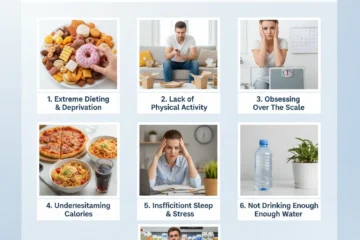
[…] Are You Struggling to Lose More Weight? […]